

Section 4.4: Digital Signal Bandwidth #
A CW signal can sound clean on its own frequency and still click in a receiver tuned a kilohertz off, in time with its dots and dashes. Keying creates sidebands around the narrow carrier.
The Shape of a Dot #
Keying speed sets how often the signal changes, and every change spreads some energy away from the carrier. Rise and fall times set how abruptly each change happens. For keying, those times make up the shape factor, not to be confused with a filter’s shape factor in the previous chapter.
Like the square wave earlier in this chapter, a near-vertical keying edge contains strong components far above the keying rate. After modulation, they become sidebands a few hundred hertz to a few kilohertz from the carrier. They aren’t RF harmonics at multiples of the carrier frequency, so a harmonic filter can’t remove them.
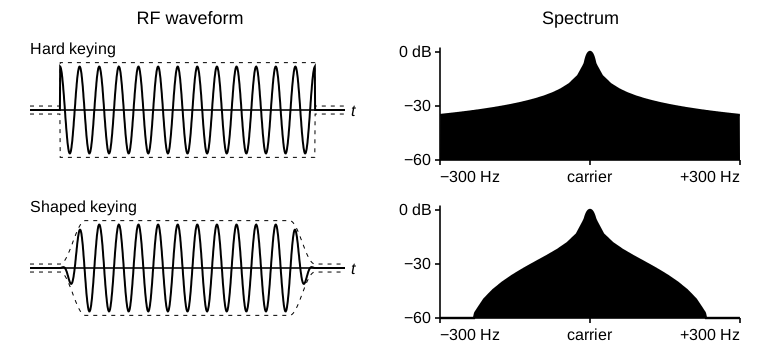
Shaped keying, in the figure’s lower row, rounds each edge, and its skirts drop away within a few hundred hertz. The edges can’t stretch without limit, though: too slow, and fast CW turns to mush as the dots blur together.
Key Information:
- Keying speed and shape factor (rise and fall time) affect the bandwidth of a transmitted CW signal.
- The primary effect of extremely short rise or fall time on a CW signal is the generation of key clicks.
- The most common method of reducing key clicks is to increase keying waveform rise and fall times.
Shaping Phase Changes #
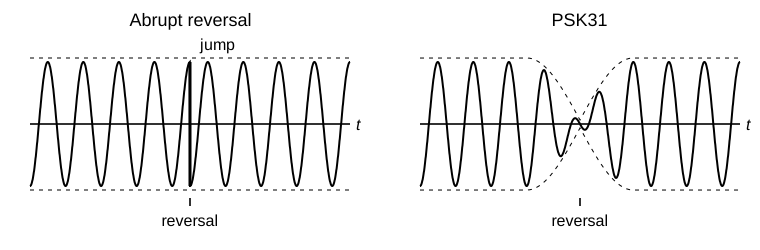
PSK31 faces the same problem with phase. An abrupt phase reversal spreads a wide spectrum, just as a hard-keyed edge does. Make the reversal at a zero crossing of the RF, and the voltage need not jump from a positive peak to a negative one. PSK31 goes further: at each reversal, it fades the carrier to zero along a sine-shaped curve, then brings it back with the opposite phase. These are its sinusoidal data pulses. A straight-line ramp would leave sharp corners at its ends; a sine-shaped taper has none.
Key Information:
- The phase of a PSK signal should be changed at the zero crossing of the RF signal to minimize bandwidth.
- The use of sinusoidal data pulses minimizes the bandwidth of a PSK31 signal.
A Mode’s Bandwidth #
A rule of thumb for normally shaped CW multiplies the speed in words per minute by four. One WPM is about 0.8 baud, and good keying needs about five times its baud rate. At 13 WPM, that gives Hz.
FT8 ends up about as narrow. It sends one of eight tones at a time, spaced 6.25 Hz apart, each lasting 0.16 second. The tone centers span seven gaps, Hz. A tone that brief is itself about 6.25 Hz wide, half of it beyond each end tone: Hz. Smooth tone changes keep it from spreading farther.
Key Information:
- The approximate bandwidth of a 13-WPM International Morse Code transmission is 52 Hz.
- The bandwidth of an FT8 signal is 50 Hz.
A faster frequency-shift-keyed signal, such as 9,600-baud ASCII sent by FM, needs much more room. Here shift means the full separation between the two transmitted frequencies, twice the deviation. A common necessary-bandwidth estimate is
where is the symbol rate in baud and is the shift in hertz. The term covers the tones’ separation, and the keying sidebands around them. For a 4,800 Hz shift,
Key Information: The bandwidth of a 4,800-Hz frequency shift, 9,600-baud ASCII FM transmission is 15.36 kHz.



 Keying speed and shape factor (rise and fall time)