

Section 4.6: Image and Television Signals #
Slow-scan television, or SSTV, sends a still picture through an ordinary voice channel, taking from a few seconds to a couple of minutes per image. Hams even use it to receive pictures from the International Space Station. The picture travels one row at a time, left to right, and the receiver must put each piece back in place.
A Picture Made from Tones #
In common analog modes, a 1,500 Hz tone means black and 2,300 Hz means white, with grays in between. Turning up the volume doesn’t brighten the picture; amplitude carries no brightness information.
Color needs more than brightness. Many common modes send each row as three scans, green, then blue, then red, and the receiver combines them. Each line starts with a short 1,200 Hz sync pulse, below the picture’s tone range, so the decoder can’t mistake it for part of the image. The picture itself begins with a short burst of tones called the vertical interval signaling, or VIS, code. Modes differ in line timing and color order, and with the wrong mode selected, the picture slants, smears, or comes out in the wrong colors.
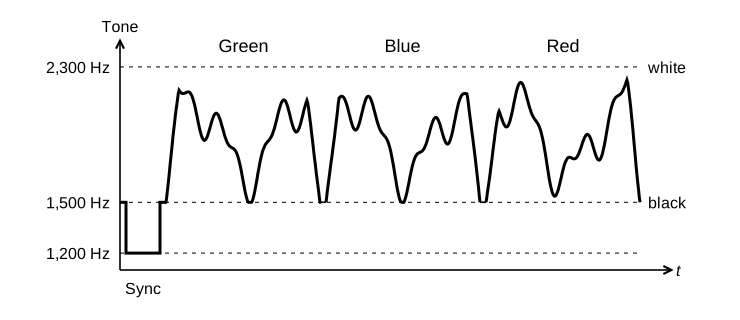
Key Information:
- In an analog slow-scan television signal, tone frequency encodes the brightness of the picture.
- In analog SSTV, color lines are sent sequentially.
- Specific tone frequencies signal SSTV receiving software to begin a new picture line.
- The function of the vertical interval signaling (VIS) code sent as part of an SSTV transmission is to identify the SSTV mode being used.
Digital image modes fit in a voice channel too. Amateur DRM spreads coded data across many OFDM subcarriers, and software turns the data back into an image file. A product detector shifts the whole signal down to audio with every subcarrier’s frequency and phase intact. An AM envelope detector would keep only the signal’s overall amplitude.
Key Information: An SSB receiver can be used to receive and decode SSTV using the Digital Radio Mondiale (DRM) protocol.
From Rows to Moving Frames #
Fast-scan television refreshes whole pictures fast enough to show motion, so it needs far more bandwidth: about 6 MHz, more than the entire 2-meter band. The analog NTSC system, named for the National Television System Committee, sends each frame as two fields, one after the other, at about 30 frames and 60 fields each second. The first field skips every other line, and the next fills in the lines between.
Analog amateur fast-scan TV uses the same format, so an analog TV set can display it if the set can tune the frequency. Some analog cable-TV channels fall inside the 70-centimeter band, and a cable-ready set can tune them.
Key Information:
- A fast-scan (NTSC) television frame is made up of 525 horizontal lines.
- An interlaced scanning pattern is generated by scanning odd-numbered lines in one field and even-numbered lines in the next.
- Transmitting on channels shared with cable TV allows commercial analog TV receivers to be used for fast-scan TV operations on the 70-centimeter band.
Leaving a Vestige #
An AM video signal would contain two full sidebands. Removing one entirely, as SSB does, would save the most bandwidth. Voice allows that because speech has almost nothing below about 300 Hz, which leaves a filter room to work. A picture’s broad areas of steady brightness produce video frequencies down to nearly zero, right against the carrier. Cutting one sideband cleanly would take an impractically sharp filter, so analog TV lets its filter roll off gradually, leaving a narrow slice of the lower sideband.
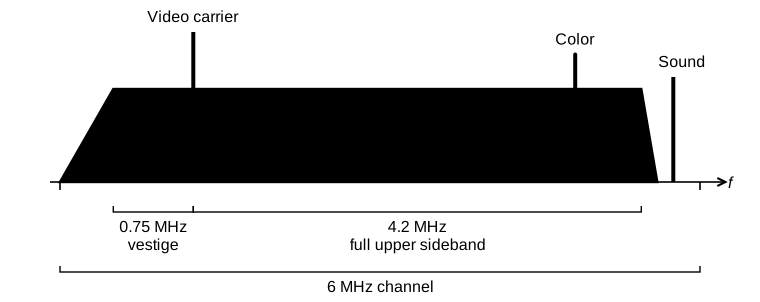
Key Information:
- Vestigial sideband modulation is amplitude modulation in which one complete sideband and a portion of the other are transmitted.
- In analog fast-scan TV transmissions, vestigial sideband reduces the bandwidth while increasing the fidelity of low frequency video components.
Video and Error Protection #
Some digital amateur TV uses DVB-T, Digital Video Broadcasting—Terrestrial. Its data rides on OFDM subcarriers like those in the previous section. Each subcarrier sends symbols from a constellation like the ones earlier in this chapter.
Before modulation, DVB-T adds forward error correction, so the receiver can repair damaged picture data without asking for a repeat. The coding rate tells what fraction of the coded stream is the original information. A rate of means three information bits for every four coded bits sent.
Coding rate isn’t picture compression, and it isn’t the guard interval between OFDM symbols, which DVB-T also gives as a fraction such as 1/4.
Key Information:
- Amateur television DVB-T signals use QAM and QPSK modulation.
- In digital television, a coding rate of 3/4 means 25% of the data sent is forward error correction data.



 Tone frequency