

Section 7.1: Ground and Tropospheric Paths #
Not every contact depends on the ionosphere. A UHF handheld’s signal seldom reaches far past the radio horizon, while an AM broadcast station, at a much lower frequency, carries far beyond the horizon in daytime. Both signals stay near the ground; frequency sets their limits.
Along the Surface #
The AM station’s daytime signal travels mostly as a surface wave, the part of ground-wave propagation that follows Earth’s curvature. The wave drives currents in the ground, and the ground’s resistance turns some of the wave’s energy into heat. That loss grows as frequency increases. Seawater, a good conductor, supports much better paths than poor soil.
A vertically polarized wave’s electric field stands perpendicular to the ground. A horizontal electric field lies along the conducting surface, which nearly shorts it out. That is why AM stations use tall vertical towers. Often the steel tower itself is the antenna.
Key Information:
- The maximum range of ground-wave propagation decreases when the signal frequency is increased.
- Ground-wave propagation supports vertical polarization.
A Horizon That Bends #
By VHF, the surface wave dies out within a short distance, so terrestrial contacts rely on waves through the lower atmosphere. The air’s refractive index normally decreases with height, so a wave travels slightly faster higher up. The top of the wavefront pulls ahead, bending the path gently downward and extending the usable horizon.
Key Information: The VHF/UHF radio horizon is approximately 15 percent farther than the geographic horizon.
An antenna about 270 feet above smooth ground has a geographic horizon near 20 miles, so its radio horizon is about miles. Hills, trees, buildings, and unusual weather can change the actual result.
Trapped in a Weather Layer #
Usually that bending is gentle. When the refractive index falls sharply with height, the path can curve as fast as Earth does, keeping the signal within a layer instead of letting it escape upward. A temperature inversion, warmer air above cooler air, can form such a tropospheric duct. A sharp drop in humidity with height can too, where evaporation keeps the lowest air much moister than the air above.
A duct traps only waves that are short compared with its thickness. Ducts over water are often just tens of feet thick, which suits microwaves. The signal must also enter the layer, which depends on the duct’s height and the antenna’s position. Once trapped, a microwave signal can ride the duct many times farther than the radio horizon.
Key Information:
- Atmospheric ducts capable of propagating microwave signals often form over large bodies of water.
- A typical range for tropospheric duct propagation of microwave signals is 100 miles to 300 miles.
Fresnel Clearance #
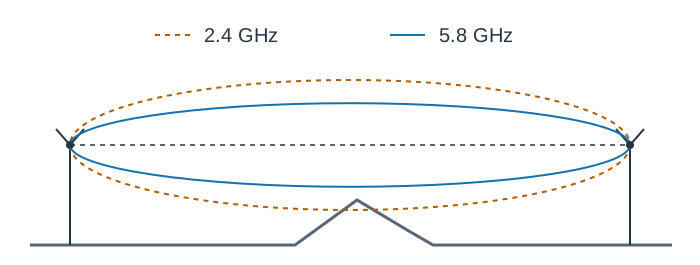
On a microwave link, you can see the other dish from your roof and still get a weak signal. Energy reaches the receiver through a broad region around the line of sight. Where a detour adds less than half a wavelength to the trip, that energy arrives close enough in step to add together. That region is the first Fresnel zone (pronounced fray-NEL), and an obstruction inside it blocks part of the energy that adds up at the receiver.
The zone bulges outward between the antennas and narrows to nothing at each end. With a longer wavelength, a detour can swing farther out before it adds half a wavelength, so the zone grows. At the same point on the same path, its radius is proportional to the square root of wavelength. Among the common microwave bands below 6 GHz, 5.8 GHz has the shortest wavelength.
Key Information: The 5.8 GHz band has the smallest first Fresnel zone.
For example, on the same path a 5.8 GHz zone has about times the radius of a 2.4 GHz zone. A ridge can therefore clear one zone while intruding into the other.




 It decreases