

Section 7.2: Ionospheric Paths #
A conversation with a distant station on 15 meters can sink into the noise around sunset, though neither operator has touched a knob. A different band may save the contact, or a different route may work. Choosing well means looking at conditions along the whole path.
Keeping a Path Open #
After sunset, ionization falls, and so does the path’s maximum usable frequency (MUF). The D region fades too, so the lower bands lose their daytime absorption.
Key Information: To continue a long-distance contact when the MUF for that path decreases due to darkness, switch to a lower-frequency HF band.
If 21 MHz no longer bends back to the other station, 14 MHz may still return. More power won’t rescue the path, because the ionosphere bends a 1,500 W signal no more than a 100 W one.
Darkness and the Long Way Around #
The fading D region matters most on 160 meters, where daytime absorption blocks distant paths. An early sunset at your location does not remove daytime absorption thousands of miles away.
Key Information: A path entirely in darkness is most likely to support long-distance propagation on 160 meters.
When the short route won’t work, long-path propagation may offer another chance. It follows the longer arc of the same great circle, so you point a directional antenna roughly 180 degrees away from the short-path heading.
A long path covers more than half of Earth’s circumference, so it usually crosses both daylight and darkness. On 160 and 80 meters, the sunlit part adds heavy D-region absorption. On 10 and 6 meters, the dark part usually drops the MUF below the band. That leaves the middle of HF.
Key Information: Long-path propagation is most frequent on the 40-meter and 20-meter bands.
Fewer Hops, Less Loss #
A long path takes many hops. A ray launched at a low angle rises gradually, so it covers more ground before it reaches the ionosphere, and as much again on the way down.
Key Information: Lowering a signal’s transmitted elevation angle increases the distance covered by each hop in ionospheric HF skip propagation.
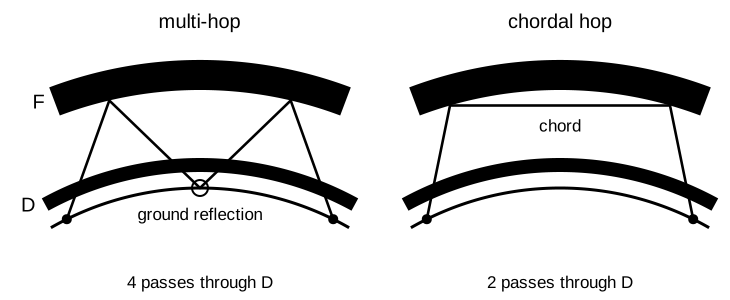
Fewer hops then cover the same distance, which is why DXers raise their antennas for the low-angle lobes from the previous chapter. In an ordinary multi-hop path, the signal comes back to Earth, reflects from the ground, and travels up again. Every ground reflection loses some energy, and the trips down through the absorbing D region and back up lose more.
Real ionospheric regions can tilt, though. A ray refracted at one point may then meet the layer again before it reaches the ground. It crosses beneath the curved ionosphere like a chord joining two points on a circle, which gives chordal-hop propagation its name.
Key Information:
- Chordal-hop propagation is successive ionospheric refractions without an intermediate reflection from the ground.
- With chordal-hop propagation, the signal experiences less loss compared to multi-hop propagation, which uses Earth as a reflector.
Across the Magnetic Equator #
Near the geomagnetic equator, where Earth’s magnetic field runs level with the ground, the daytime ionosphere takes a shape that suits such hops. Ionization collects into two dense bands roughly 10 to 20 degrees north and south of that line. The line follows the field rather than the map, so it wanders north and south of the geographic equator.
A VHF signal can refract from one band to the other without touching the ground, much like a chordal hop. This is transequatorial propagation, or TEP. It works best when the stations sit on opposite sides, about equally far from that line, so the signal bent by one band reaches the matching part of the other.
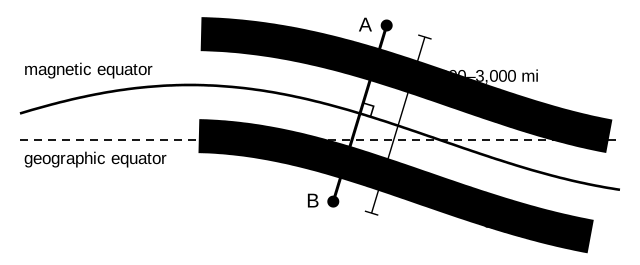
The bands build through the day and peak in the afternoon. In the evening a second type, evening TEP, rides on long, uneven patches of ionization stretched along the magnetic field.
Key Information:
- Transequatorial propagation is most likely between points separated by 2,000 miles to 3,000 miles over a path perpendicular to the geomagnetic equator.
- The approximate maximum range for signals using transequatorial propagation is 5,000 miles.
- Transequatorial propagation is most likely to occur in the afternoon or early evening.
Real paths vary, and afternoon TEP often runs somewhat longer than 3,000 miles.
Two Waves in One Path #
The magnetic field also changes how a wave travels through the ionosphere: the ionized medium splits it into two modes, the ordinary and extraordinary waves. They follow slightly different paths. In each, the electric field rotates as the wave travels, and its tip traces an ellipse.
Key Information: Extraordinary and ordinary waves are independently propagating, elliptically polarized waves created in the ionosphere.
The two waves reach the receiver with a shifting phase difference, so their combined polarization keeps changing. That is one cause of fading. The shifting polarization also means vertical and horizontal antennas both work for HF skywave. A vertical in a small yard and a dipole strung between two trees can both work the same distant station.
Dense Patches in the E Region #
Six meters can sit silent for hours, then fill with strong signals from half a continent away, then go quiet again. That is sporadic E, often written , and a big reason hams call 6 meters the Magic Band. Thin, dense patches of ionization form within the E region, drift, and fade. While they last, they can return frequencies that would otherwise pass through, including VHF. Sporadic E can’t be scheduled, but seasonal and daily patterns suggest when to listen.
Key Information:
- Sporadic-E propagation is most likely to occur around the solstices, especially the summer solstice.
- Sporadic-E propagation is most likely to occur between sunrise and sunset.
A smaller peak comes near the winter solstice, and nighttime openings occur too.



 Switch to a lower frequency HF band