

Section 8.1: Towers and Lightning #
A taller antenna is hard to resist when you’re chasing weak signals. Someone still has to put it up, and climb back up the day a connector lets in water. Before anyone climbs, the usual rules apply: never climb alone, check the harness rating and service life, lock out and tag circuits feeding the tower, and keep its antennas off the air. None of that replaces climbing training, suitable fall-protection equipment, and a rescue plan.
Staying Attached to the Tower #
A lanyard connects the climber’s harness to an anchor; a shock-absorbing lanyard also helps limit the force of a fall. The harness, lanyard, anchor, and available clearance must work together as a fall-protection system.
A lattice tower has three or four upright legs joined by cross braces that climbers often use as rungs. The legs carry the tower’s load. Rungs and guy brackets aren’t meant to hold a falling climber, and a lanyard around the mast can slide or turn with it.
Moving up means unclipping, so a climber uses two lanyards, clipping one at the next anchor before releasing the other. The higher that anchor sits above the harness, the shorter the fall before the lanyard catches, and the smaller the jolt.
Key Information:
- 100% tie-off means at least one lanyard attached to the tower at all times.
- While climbing, attach lanyards to the tower legs.
- Attach a shock-absorbing lanyard to the tower above the climber’s head level.
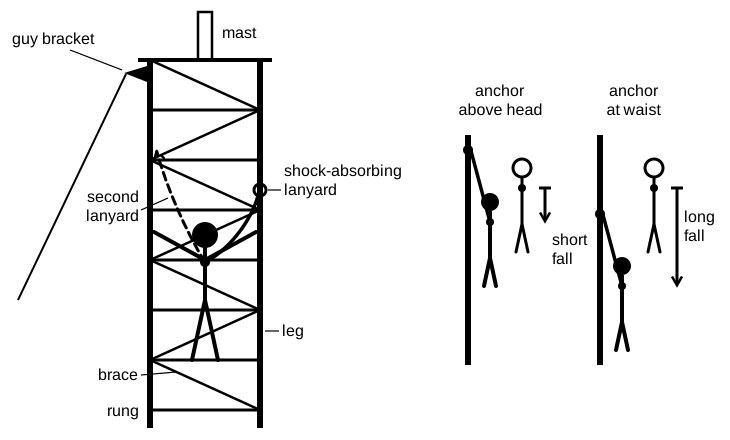
Even on a leg, use anchor points and equipment approved for the tower and fall-protection system. Follow the manufacturers’ instructions.
Give Surges a Common Path #
A tall tower also makes a likely target for lightning. A strike’s charge needs a path to earth outside the building.
Key Information: The primary function of an external earth connection or ground rod is lightning charge dissipation.
Some surge current still reaches the station’s cables, and it can enter on one cable and leave through another. A single point ground panel keeps your radio from completing that path. It’s a conductive panel where the cables enter the building, and every line’s protector, or arrestor, mounts on it. The AC line counts too: a surge often leaves the radio that way. Each protector diverts a surge when its line rises too far above the protector’s ground connection. On a shared panel, those connections rise and fall together, so no line ends up at a very different voltage from the others.
Key Information:
- The purpose of a single point ground panel is to ensure all lightning protectors activate at the same time.
- A station AC surge protector should be installed on the single point ground panel.
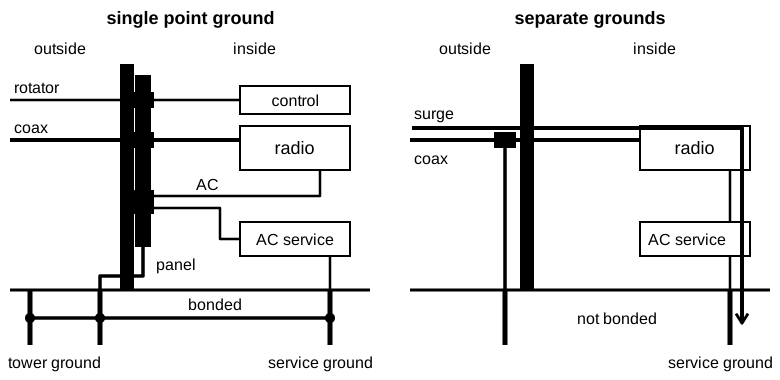
Connect the panel to the outside ground rods with a short, direct conductor, and bond that system to the building’s electrical service ground. Separate, unbonded ground rods put the radio back in the surge’s path. A ground rod does not replace the AC equipment-grounding conductor.
Use surge protectors suited to each line, following their instructions and applicable electrical codes. Have a qualified electrician handle AC wiring. These measures reduce risk, but they do not make it safe to work on the station or tower during a thunderstorm.



 At least one lanyard attached to the tower at all times