

Section 7.5: Fun with Amateur Radio #
Now for some of the more colorful corners of the hobby. We’ll start with a few activities that you might encounter on the exam, then look at a handful of others worth knowing about even though they aren’t tested.
Fox Hunting and Direction Finding #
Ever fancy yourself as a radio detective? Then you’ll love fox hunting — a ham radio term for radio direction finding. This technique involves using directional antennas and receivers to determine the location of a radio signal. In a fox hunt, the “fox” is a hidden transmitter, and your job is to find it using your radio skills and some clever equipment. It’s like a high-tech game of hide-and-seek.
Key Information: Radio direction finding is used to locate sources of noise interference or jamming.
Here’s how it works:
- Someone sets up a low-power transmitter (the “fox”) in a secret location.
- Hunters use a directional antenna and a receiver’s signal-strength reading to track down the signal.
- The first person or team to find the transmitter wins!
Fox hunting helps you develop valuable skills like understanding radio wave propagation, emergency communications practice, and hands-on experience with directional antennas. To get started, you just need a handheld radio, a directional antenna (like a Yagi) , and an attenuator. Many clubs organize regular fox hunts, making it a great way to meet other hams and have some outdoor radio fun.
While this is often done as a fun activity, it’s also a genuinely useful skill — especially when it comes to tracking down sources of interference or jamming.
🔥 A few local hams heard complaints from neighbors that garage doors around the neighborhood had mysteriously stopped working. Curious, they decided to investigate with a spectrum analyzer — and discovered a strong signal sitting right on the frequency used by the garage door openers. Naturally, they grabbed their direction-finding gear to investigate.
The signal led them straight to the garage of one of the hunters. A repeater setup inside had developed a loose connection, which allowed signals from the repeater and a nearby broadcast station to mix and produce unintended interference.
The operator responsible — who may or may not have been a primary contributor to this very book — was mildly surprised and quietly mortified. But that’s the value of direction-finding: it works, even when you’re the problem.
Contesting #
Key Information:
- Contesting is an operating activity that involves contacting as many stations as possible during a specified period.
- Good practice when contacting another station in a contest is sending only the minimum information needed for proper identification and the contest exchange.
Ever felt the thrill of a race? Ham radio has its own version of high-speed competition. Contests are events where hams compete to make the most contacts, often with specific goals like working different countries, states, or grid squares. Some last a few hours, others a full weekend. It’s like a global radio party!
For each contact you’ll exchange brief info — usually a signal report and some other data like your location or a serial number. Save the lengthy chats for another time; in a contest, fast and accurate is the name of the game.
Why contest? It’s a great way to improve your operating skills, test your station’s performance, and maybe snag some rare locations for awards. Plus, the adrenaline rush is real! Many contests have sections for newcomers or low-power stations, making them a perfect way to dip your toes into the contesting waters.
Grid locators #
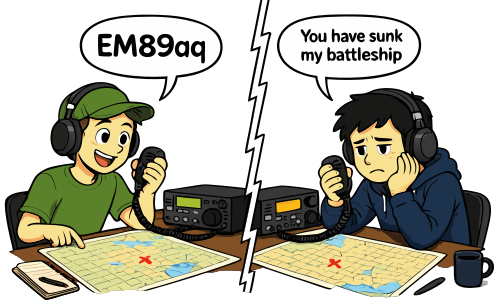
Now, let’s talk about a cool tool used in many contests: grid locators. A grid locator is a letter-number designator assigned to a geographic location on Earth. For example, “FM18” covers the Washington D.C. area. In contests, you might exchange grid squares instead of states or countries. It’s like a global game of battleship!
Grid locators aren’t just for contests — they’re useful for satellite operations, VHF/UHF work, and even general ragchewing when you want to share your location.
Here are some examples:
| Landmark | Address | City, State, ZIP | Grid Locator |
|---|---|---|---|
| Statue of Liberty | Liberty Island | New York, NY 10004 | FN20xq |
| Golden Gate Bridge | Golden Gate Bridge | San Francisco, CA 94129 | CM87st |
| White House | 1600 Pennsylvania Avenue NW | Washington, D.C. 20500 | FM18lv |
| Space Needle | 400 Broad St | Seattle, WA 98109 | CN87to |
| Graceland | 3764 Elvis Presley Blvd | Memphis, TN 38116 | EM45xb |
These examples show how grid locators can pinpoint locations across the United States. Notice how the first two characters (like FM, CM, etc.) give a rough idea of the region, while the following characters narrow down the specific location. This system allows hams to quickly communicate their approximate location without needing to exchange detailed coordinates.
Beyond the Exam: More Ham Radio Adventures #
Now that we’ve covered the operating activities you need to know for the exam, let’s explore some other exciting aspects of ham radio. While these topics won’t be on your Technician test, they represent the incredible diversity of this hobby and might inspire your next radio adventure!
Ham Radio Mesh Networks #
Imagine creating your own mini-internet using radio waves. That’s what mesh networking is all about. Hams are setting up networks of nodes that can pass data between them, creating a robust, decentralized communication system. It’s a wide area wireless network that doesn’t go down when your ISP does!
APRS (Automatic Packet Reporting System) #
We talked about this a bit in Section 3.5 — think of APRS as social media for your radio! It lets you transmit your position, weather data, and short messages over ham radio. Imagine a real-time map showing where hams are operating, complete with status updates and local information. It’s especially useful during public service events or emergencies, allowing coordinators to see where their operators are at a glance.
SOTA (Summits On The Air) and POTA (Parks On The Air) #
How about combining radio with the great outdoors? These activities challenge you to make contacts from mountaintops or state/national parks. It’s a perfect blend of hiking and radio. Nothing beats the thrill of making a contact from a remote peak using a radio and antenna you carried up yourself!
Software-Defined Radio (SDR) #
For the tech-savvy hams, SDR turns your computer into a powerful radio receiver (and sometimes transmitter). With SDR, you can decode digital signals, track aircraft, listen to satellites, and even receive images from weather satellites. It’s like having a super-radio that can do almost anything!
EME (Earth-Moon-Earth) Communications #
Love space? Try EME, also known as moonbounce. Yes, you can literally bounce radio signals off the moon to communicate with other hams. It’s challenging and requires some serious equipment, but how cool is it to use the moon as a giant radio reflector?
DIY Projects #
For the builders and tinkerers, there’s a whole world of DIY projects. From constructing your own antennas to building QRP (low power) transceivers, the possibilities are endless. It’s like adult LEGO, but with the satisfaction of making contacts on gear you built yourself!
Digital Modes #
While not exactly new, modes like FT8 are revolutionizing how we make contacts. Using these modes, you can communicate around the world with very low power and compromised antennas. It’s like having a superpower that lets you whisper across continents!
That wraps up Chapter 7 — and most of what you’d actually do on the air. The final chapter pulls together the rules side: who can operate where, what’s authorized, what isn’t, and how the FCC structures the whole thing.



 Radio direction finding